
E37 The Future of Counterterrorism
On the morning of September 11th, 2001, the United States experienced a terrorist attack that changed everything. While travel, immigration, and international relations were all significantly altered, one change that many of us don’t know about is the way law enforcement monitors, apprehends, and prosecutes terrorist activity.
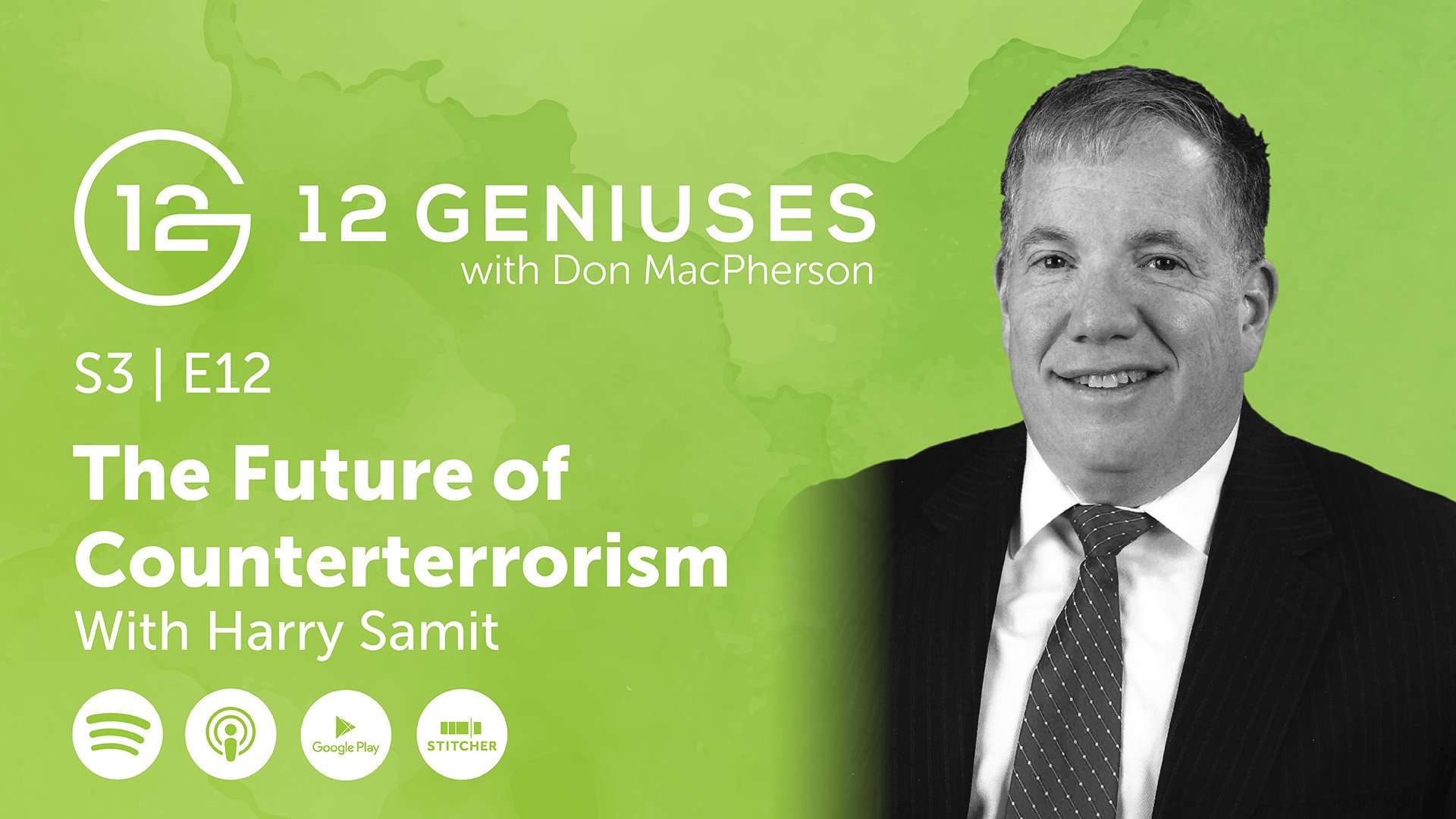
In this interview, Don MacPherson is joined by Harry Samit. Harry is a former FBI agent who served on the Joint Terrorism Task Force in Minneapolis. He was an integral member of the team of agents who tried to stop the 9/11 attacks. They discuss the events leading up to 9/11, including the arrest and investigation of al-Qaeda operative Zacarias Moussaoui. They also explore how terrorism is still expressed around the world today and the threats the U.S. faces from foreign and domestic terrorists. Harry shares his perspective on how counterterrorism will evolve and the ways in which agencies will change in order to monitor suspicious behavior in the United States.
Harry Samit is a former United States Navy Naval Intelligence Officer. After his Naval career, Harry spent 21 years in the FBI and was a founding member of the Minneapolis Joint Terrorism Task Force. In the months and years following the attacks on 9/11, Harry was also a key figure in analyzing ways to prevent future terrorist attacks.
Don MacPherson:
Hello, this is Don MacPherson, your host of 12 Geniuses. For 25 years, I've been helping organizations and the leaders who run them improve performance. Now I travel the world to interview geniuses about the trends shaping the way we live and work. There are two trends that have dominated the last 20 years. The first is the incredible advancement in computing technology. It's transformed just about every element of human life. The second trend is the rise in terrorism. While terrorism has been a reality for many years, the acts of 9/11, 2001 ensured a response that would change the lives for billions of people around the world.
Our guest today was a central figure in the investigation of those violent crimes. Harry Samit is a retired FBI agent, best known for the arrest of al-Qaeda operative, Zacarias Moussaoui. Harry and I talk about 9/11, how those attacks forever changed counterterrorism. And we discuss how terrorism is shifting from violent foreign organizations to domestic terrorism.
This episode of 12 Geniuses is brought to you by the Think2Perform Research Institute, an organization committed to advancing moral, purposeful, and emotionally intelligent leadership. You can learn more and access the Institute's latest research at T, the number 2, pri.org.
Harry, welcome to 12 Geniuses. You are a retired FBI agent. Could you start off by talking about your career pre-FBI?
Harry Samit:
So, I grew up in Philadelphia, Pennsylvania, on the East Coast — Fairly normal upbringing. I went to a public high school. After that, I went to Penn State, in State College, Pennsylvania. I attended there on a Navy ROTC scholarship. That's what made college fun and interesting for me, because I always wanted to be a naval officer. That's something, growing up, that was what I wanted to do. After four years, I was commissioned as an ENS in the Navy. I spent 10 years on active duty as an intelligence officer, serving in a variety of different commands, almost all related to aviation. Along the way, I picked up my private pilot's license. But in 1995, there was an event, I think we all remember, that really caused me to kind of change course, and that was the Oklahoma City bombing.
I think, like a lot of Americans, I was shocked by that. I hadn't heard of terrorism before. I didn't know that there was such a thing as terrorism, let alone that there was domestic or international terrorism. And when that happened, it really jolted me because I'd been focused my whole career on external threats — overseas threats. And now, for the first time, I became aware that people in the United States hated the government or hated groups of people and wanted to hurt our citizens. And so, I decided that I was going to change course and become an FBI agent. In 1995, I casually started applying. I figured I was a naval officer; I was a pilot; it would be relatively easily to get hired. And that wasn't the case. It took me four years. So, I wasn't actually able to start the FBI Academy until January of 1999.
Don:
And what were you doing when you initially became an FBI agent?
Harry:
I went through Quantico. My first four plus months was training and all things law enforcement, federal law enforcement. About six weeks into that process, I found out I was coming to Minneapolis, to the Minneapolis Field office. The Minneapolis Field Office was just starting its own joint terrorism task force.
Don:
And what does that mean? Is that a group of local police and sheriffs and FBI federal agents? What does that ‘joint team’ mean?
Harry:
Exactly like you said, it brings together state, local, and other federal investigators together in a cohesive unit that work together. We partner up with other agents from other agencies or police officers from other departments, and we investigate terrorism. And so, it brings together all these other folks. And that really has two advantages. The one advantage is additional manpower, right? We get other investigators. The JTTF, at the time, probably had seven or eight FBI agents on it, and four or five task force officers, which is police officers or agents from other federal agencies. So, they nearly doubled our size right there. So, the manpower thing is a huge bolster to the capabilities. But then also jurisdictionally, we get increased jurisdiction by having police officers and federal agents from other agencies. Because if you add an immigration agent, as we did, then we have someone who can work immigration issues.
If we add a police officer, then someone who can work state and local crimes. And so, that really gave us an increased capability. And so the manpower and the increased jurisdiction are the hard capabilities that somebody can quantify on a piece of paper. The soft advantage, the soft capability is some really skilled, experienced investigators who had been there and done that and seen a lot of things. That was the intangible bolster to our capabilities. But that summer of 1999, when those new folks came on board, it really enhanced our capabilities.
Don:
And how big was your area of responsibility or your jurisdiction?
Harry:
So, the Minneapolis Field Division is the whole state of Minnesota and then North and South Dakota.
Don:
How do you define terrorism? What does it include or exclude?
Harry:
I'll give you the FBI, kind of the standard U.S. government definition. And I think it's a pretty good one. It's a group of people committing violence in order to coerce a government or population politically. What that includes is any either act or threat of violence that is intended to coerce people into doing something politically.
Don:
That's really interesting because what has been puzzling to me is that a lot of times mass shootings are not included in terrorism statistics where I would… just looking at the word terror, that is a very terrifying episode. But the reason I asked that is I wanted, for the rest of the conversation here, to let people have a pretty good idea of what the working definition is here.
Harry:
I think that's a fair one. To take your mass shooting example, if there's no political objective, if there's no attempt to coerce a population, however terrifying it is, and I completely agree, and however violent and tragic and all those things are, if the person is motivated to do the shooting, even by a grievance, which is a major part of terrorism too, if they're not trying to coerce a population — if they just want to send a message that they're angry or hate filled, or any of the variety of reasons behind, motivations behind these mass shootings, it's still not terrorism.
Don:
So, about two and a half years into your career, you became pretty well known. Could you talk about August of 2001, what happened, and how things unfolded from there?
Harry:
On August 15th, 2001, was a summer day in Minnesota. I was an agent on the JTTF. I'd had two and a half years under my belt. I think it's safe to say that I'd seen everything in international terrorism about one time. So, by two and a half years in, I think I'd seen everything once. I wouldn't say I developed any particular expertise, but at least I had experienced things. The duty agent that day was an agent named Dave Rap. Dave was a brand new agent — I want to say he had less than six months in the FBI. And because of that, when he received a call from a person, and what the duty agent does is they take calls from the general public and walk-ins from people, and so he was doing his job and he got a call from a flight instructor at Pan Am International Flight Academy in Eagan, who had a student that was very suspicious.
The flight instructor who called from the flight school said that they had a student unlike any that they'd ever experienced before. He didn't have a pilot's license, but he was paying for very expensive simulator time to learn to fly the Boeing 747-400 series airliner. They believed he was foreign and he just was suspicious and evasive, and they were concerned. And they called the FBI.
Don:
No one who's new to flying would start with a 747, right?
Harry:
Right. Correct.
Don:
So, then what happened after that? You got this tip from somebody in Eagan, Minnesota at this flight school, what happens next?
Harry:
One of the first things we did was determined that he was not a U.S. citizen, which changes the threshold for our ability to open an investigation. And it's easier for us to open a case on someone who is not either a U.S. citizen or a legal permanent resident. Based on the fact pattern, the foreign connection, the suspicious flight training, we were able to open an investigation. Although television doesn't do a great job of this, one of stock-in-trade tools of being an FBI agent is this thing that, whether it's Quantico or Criminal Minds, or any of the other FBI shows out there, really don't emphasize, but is the most important thing about being an FBI agent, and that is talking to people. So, one of the first steps that we took was I called the flight instructor who had spent the most time with Moussaoui just to get his feel.
Don:
So, we are talking about Zacarias Moussaoui, for people who are listening. To spill the beans here, we're talking about the 20th hijacker from the 9/11 attacks — Zacarias Moussaoui. That's the case we're talking about here. So, take us back to the morning of the 15th.
Harry:
We finished out the morning of the 15th doing background checks to see what we could find on Moussaoui, which was very little. FBI had almost nothing on him. Immigration, and this is the value of the JTTF — We had an immigration agent right there who ran him and discovered something that we rarely, if ever get in a case, and that is that he was arrestable right away. The reason that he was is because he had come into the United States as part of the Visa Waiver Program, which is a tourist visa. Essentially, if you come from Western Europe or some countries in Asia, you can get into the United States without a visa. Provided, there's two big conditions — One is that you come as a tourist, that you're not going to work or study or do anything like that. And two, that you depart in 90 days.
Moussaoui agreed to those conditions, but he didn't follow those because he, of course, enrolled as a flight student. And then in August, from February to August was here well over 90 days. So, right away he was arrestable. Early that afternoon, I called his flight instructor and spoke to him on the phone. I wanted to get a sense for the impetus for the person behind the suspicions just to see if he was credible, if he was someone who was maybe well intentioned, but a little unstable. And the guy was a retired Northwest Airlines airline captain, and he was completely credible. And he told us a bunch of things about his student that really raised concerns.
Don:
And what were those concerns or what were the… He paid cash, and 747, no background.
Harry:
Right. No pilot's license, but he wanted in-depth training in the 747-400. He paid cash. He was very suspicious about his background. The flight instructor found him very chatty and willing to talk and sociable, but he wouldn't discuss himself. And so, that struck the flight instructor as odd.
Don:
So, this is the 15th. What happens after the 15th?
Harry:
So, on the 16th, we agreed to meet the flight instructor in person. We wanted to talk to him one more time. We went to the flight school early on the 16th and got Mr. Moussaoui's flight schedule. The staff there cooperated. And we saw that Moussaoui was scheduled for his first live simulator session at 6:00 PM that night. That was significant because, up until that point, he hadn't touched a simulator yet. He hadn't put his hands on the controls. Everything had been classroom or manuals. He hadn't touched the simulator. And so, we decided we were going to talk to his flight instructor. We're going to sit down with that gentleman and do an interview, which we did in the lobby of his hotel. And based on what we heard from there, we would make a game-day decision, but we were leaning very heavily towards arresting him right then and there so he couldn't get his hands on the controls of the 747.
Because as a pilot, I understood, and my supervisor on the squad was a pilot too. We all understood there's a huge difference between academics and classroom learning and what it means to actually pilot an airplane. So, we had a chance just luckily to arrest him, to head him off before he got his hands on the controls and gained any skills at all. And so, we were determined to do that.
Don:
So, you arrest him on the 16th?
Harry:
Yep. Around 5:10 PM, he came out of his hotel. We set up about 4:00 PM in a surveillance configuration. It's laughable when I tell this to new agents today — there were only four of us out there. There were two immigration agents and two FBI agents. In this day and age, the post 9/11 era, there would be six, eight, 10 people out there for the arrest. But back then, there were four. He was staying in the hotel with a companion, a student from the University of Oklahoma who drove him up here from there. The student came out of the hotel first, we detained him, and then about five minutes later, Moussaoui came out and we arrested him.
Don:
And at that point, what sort of suspicions did you have about him?
Harry:
Everything was increasing. Concerns were increasing based on what the flight instructor said, and then what the information provided by the flight school. The cash payments; that only amplified it. When we achieved our first contact with Moussaoui and talked to him, he behaved very atypically as well. Everything he did was alerting.
Don:
Like what?
Harry:
He was very belligerent and combative. And in our experience, an innocent person in that situation, even a harmless crackpot or somebody who's an aviation enthusiast would say, “Ah, you're right. I made an immigration mistake. Sorry, my problem.” But he became belligerent. He had a weapon at the time we searched him. He had a dagger in his pocket, which again, not something a normal person would carry. Once we placed him in handcuffs and put him in an immigration vehicle to transport him, I tried to get him to calm down a little bit and talk to him —pilot stuff and just say, “Hey, I fly, you fly. Let's talk. It's my experience most people like to talk about, who are pilots, like to talk flying. He had no interest in that. Just a variety of things. And then, once he was gone and had been taken to the immigration custody facility, we started to interview his companion, and what the companion told us was incredibly alarming.
Don:
Like what?
Harry:
The companion was a co-conspirator for sure. He had some degree of knowledge Moussaoui was here to carry out something on behalf of a foreign power. He knew Moussaoui was an Islamic extremist. This was not a straightforward linear interview. His companion name was a guy named Hussein al-Attas. Mr. al-Attas was very resistant to our interviews. But at length, and then probably at the end of a two-hour interview, he acknowledged that Moussaoui was an Islamic extremist; that he supported violence against non-Muslims. He would not acknowledge knowing about any plot or any plan, but he painted a pretty concerning picture of his companion.
Don:
Who was interrogating Moussaoui on the night of the 16th?
Harry:
So, he was transported to the facility. We talked to his companion first. And then after his companion, myself and my partner, [John Weis 0:15:28], an immigration agent, he and I then went and interviewed Mr. Moussaoui that night.
Don:
Okay, for how long?
Harry:
Probably about 90 minutes.
Don:
And what did you get out of him?
Harry:
That interview was remarkable more for what he did not reveal. Obviously, Mr. Moussaoui was, as we know now, a camp-trained al-Qaeda fighter and operative who was sent to the United States by Osama bin Laden to crash an airplane into the White House. However, his behavior that night, at least his cover story, was that he was a businessman. He came to the United States to learn how to fly. He had family taking care of business back in the UK and in France where he was based. This was all just a big misunderstanding. And so, we asked some very basic questions. What's the name of your business? Where did you earn your money? What products do you sell? Where have you worked in the past?
And he couldn't answer any of those questions. The interesting thing is too, that there was an underlying hostility towards us that's just not common, right? He's the guy that made the immigration mistake. We're trying to get the facts, and we could tell he really was hostile towards us and hated us.
Don:
What sort of interactions do you have with him after the 16th?
Harry:
We interviewed him again the next day. John and I agreed that, at the outset, that we were not going to push too hard the first night. There's a couple of reasons for that as an interview technique. We want to start fresh again the next day. We want to give him a night to sleep on it. We also want to create the impression that we've done background check so that when we come in the next day, we could say, “We found a bunch of stuff on you.” Which wasn't true. And so, we transported him to an immigration, to a county facility that had immigration contract. So, he spent that night in jail and then we brought him back the next day. We reinterviewed his friend, Hussein al-Attas, that morning, and got him to make some additional admissions. And then in the afternoon of the 17th, we re-interviewed Mr. Moussaoui.
Don:
And between the time you arrest him and September 10th, you have a pretty good idea that there's something big going on, and you're trying to get access to evidence or some sort of search warrant or something like that? What's happening between those two dates — August 17th and September 10th?
Harry:
So, when we arrested Mr. Moussaoui, we went back into his hotel room with him because he claimed he had immigration documents that could show he was legally in the United States. When we got in the hotel room, we could see that he had almost all of his household goods with him. He had notebooks, he had documents, he had a laptop computer. Picture what a person in a small apartment would have. Of course, we did what any law enforcement officer does, what any investigator does, and we asked him for consent to search those items — and he emphatically denied that. He said, “Absolutely not.”
Don:
So, if you're in the room, you still don't have a right to search.
Harry:
Absolutely. The only thing, and this is kind of legal 101, but the only thing we had a right to search was…
Don:
His person?
Harry:
Exactly. Incident to arrest, we were able to look at anything on his person, but because we caught him on the sidewalk outside the hotel room and it was outside of his lunging area. And we certainly couldn't read through documents or access his computer hard drive without a search warrant. So, we asked him, he said, no; emphatically no. Again, not typical of someone who's innocent is this… make such a vehement objection to our even asking him. So, the only solution for us to conduct a search was a search warrant.
Don:
Could you have gotten consent from his companion since they were in the hotel together?
Harry:
We could, and we did get consent to remove Moussaoui's goods from the hotel room and transport them to immigration, but we couldn't get consent to do things like read his books. And so, his friend did give us consent to search his stuff, and we did. We searched al-Attas’s stuff.
Don:
Let's imagine that you had access to his notebooks, his laptop, computer, etc., and were able to investigate them prior to the September 11th, what do you think could have happened?
Harry:
Good question — Well phrased. Because the question I get all the time in that same note is, could you have stopped 9/11? I always stay away from the counterfactual because I don't know the answer to that. What could have happened? So, the material contained, especially in the notebooks; now, naturally we saw the laptop computer and probably the dozen or more notebooks, but we focused on the laptop computer first, right? That could potentially contain the most information. So, the laptop was the focus of our interest. Ironically, it didn't have a lot. After 9/11 when it was searched, it was found to have been essentially wiped. The hard drive was wiped prior, sometime prior to our getting our hands on it. But what was in the notebooks would have been enough to link him to the hijackers, and, in fact, was enough to link him to the hijackers after the 9/11 attacks. The big question, which I think will always have to remain unanswered is, could we have done it in the three and a half weeks?
Don:
Would you have investigated the co-conspirators? Right?
Harry:
Right. Like I say, the information would in the notebooks would certainly have gotten us to the co-conspirators. The question is, though, would we have been able to do that as quickly? Post 9/11, there was obviously a lot of impetus. It required the cooperation of the German government, which post 9/11 came fast and furious. Now, can I have said that in the third, fourth week of August, 2001, would the Germans have been that quick? I don't know.
Don:
Did the FBI, at that time, think that an attack of the size, scale, sophistication of 9/11 would even be possible?
Harry:
Here in Minneapolis, could we have imagined a multiplane suicide attack? I don't know. We certainly imagined a single plane suicide attack with Mr. Moussaoui. Because the other question that I and others on my squad at the time get all the time is, “How do you know he was going to carry out a suicide attack using an airliner?” You couldn't possibly have predicted that before 9/11. Well, the short answer is that we did, and the reason that we were able to do that is this — The histories vary, but the different places I've researched it, the first hijacking of a commercial aircraft took place in the ‘20s or ‘30s. I've seen both, but 70 years ago, 80 years ago. And at no time between 1927 and 2001 had any hijacker ever needed to have flight training. You don't need to know how to fly an airplane to hijack it, right? You put a gun or a knife to a flight attendant's head and the pilot will fly you where you want to go — Cuba, Angola.
Don:
And do it safely.
Harry:
And do it safely. And do it better than you could.
Don:
Right. That's absolutely right.
Harry:
Because it's his airplane. Yeah. So, why do you need to learn how to fly the airplane yourself? The only answer is, is because you're going to do something with that airplane that you can't make the pilot do. And what is that? There's only one answer to that. And so yes, before 9/11, we imagined at least a one airplane suicide bomb.
Don:
And then what became your focus starting on 9/11 or the day after?
Harry:
So, absolutely what ultimately became the PENTTBOM major case, the Pentagon Bombing major case. Probably for the next year plus, that's all myself and my partner, John Weis, did was work this case towards identifying other living coconspirators and then preparing for the trial.
Don:
Do you have any regrets regarding how things played out or I guess personal regrets? I'm sure you have regrets that you didn't get the search warrant.
Harry:
I do. Experience is the best teacher and adversity, for sure. If I had it to do over again, I would've elevated it even higher. I was insubordinate, I was aggressive. I did all the things and exceeded all the things that were considered good etiquette for a two and a half year agent to do. If I'd been a 21-year agent at the time, I absolutely would've gone higher. I would've called the director himself. To save 3000 lives, I would've done anything within the law — And I regret that I didn't do that.
Don:
Could you talk about the state of counterterrorism today or maybe just start with the state of terrorism today?
Harry:
So, I think as incidents recently in France, or in Austria and France have shown us, these Islamic extremists, the international scene, they're not going to go away. They are struggling to be relevant. They are struggling to have a voice. Certainly in France, they're at odds with the government constantly trying to coerce them by increasingly horrific acts of violence — beheading a teacher. That shows us it hasn't gone away. One of the biggest things that's caused the threat, I think the perception that the threat has diminished in the United States is that, by and large, the destruction of the Islamic state overseas by the military in the last three years, the fact is, and as much as Americans don't like their troops overseas, and frankly, I don't either, fighting them overseas is a great alternative to have them running rampant here in the United States.
And so, to the extent that they can be dislocated and kept off balance in their havens, in their safe havens overseas, it really diminishes the threat here in the United States. As long as that continues where we use air power and drones and special operations forces overseas to continue pursuing them into their havens, I think they're going to be too off balance to launch attacks — organized 9/11 types attacks into the United States.
Don:
Okay. So, you're basically saying that extreme Islam is declining, but it has not gone away. The huge attacks have not seemed to have happened in the last couple years. Is that accurate?
Harry:
It is. It's accurate. I would not characterize extreme Islam as declining. What I would say is that the destruction of these groups overseas has hurt their ability to finance, to inspire, to train, to provide guidance to people who are dormant in the west to carry out these attacks. And so, when the military does things like go in and kills Baghdadi or kills bin Laden, it really destroys a significant capability of the group to project its power, and so keeping them off balance. Now, the grievances are there. The angry people are there. They're just on the run. They just don't have the capability to project power. As soon as that pressure is taken off, and as soon as they can establish a safe haven and finance, and with the ready availability of social media, they'll be able to inspire again.
Don:
That's a really good point. So, it's not dead, but it's maybe a little dormant, or they are on the run. And when you're on the run, it's very difficult to mobilize, communicate, inspire, like you said. Where are the threats to U.S. citizens today?
Harry:
The Islamic state’s not dead. Al-Shabaab in Somalia still remains a viable threat. There's al-Qaeda offshoots in a variety of different countries where they're actively aspiring to carry out attacks or planning to carry out attacks. There's also the white nationalist, white supremacist movement, which is becoming international — Any group of people that has a grievance. And it’s an important point to talk about today and compare and contrast it to yesteryear. 50 years ago, 60 years ago, there were people with grievances. There were people who wanted to use political power and coerce, but they didn't have social media. Really, the only enemy that they could see, and the only enemy that they could inspire their operatives against, and really the only way to project power was against the local threat.
So, the globalization of communications and the internet has made it a worldwide thing. And so now, one thing that no PLO operative had in 1972, but every terrorist has today is a smartphone in their pocket. That smartphone is not only communication with people anywhere in the world, but it's a storehouse; it's a library full of knowledge.
Don:
Today is November 13th, 2020. We just had an election last week. There's a President-elect Joe Biden. President Trump, as far as I know, has not conceded the election. I've not been following the news today. Are you concerned; would you be concerned that there could be some terrorist activity as a result of what's happening with this election?
Harry:
For sure. We've seen with the spring, through summer, through fall with the tensions rising high, running high in the United States — Absolutely. I've said the word several times throughout this discussion and whether it applies to an international terrorism organization or a domestic terrorism organization, it's the word grievance. And people in 2020, in November of 2020, people have grievances. Are the grievances right or justified? Certainly, I don't think al-Qaeda's grievances are justified. Certainly, I don't think the white nationalist grievances are justified; the Marxists, any of these people with grievances. They never justify violence. I think everyone with a grievance certainly has reason to be aggrieved, whether historically or in the present day, but I don't think any of those, in 2020, justify rioting, or shooting, or bombing, or any of the types of violence that we see associated with terrorism. And so, I would hope, although, to answer your question, yes, I think there's a threat, I would hope that people would be able to handle these things through litigation or social change, but I'm not optimistic.
Don:
I think some of the people who are feeling aggrieved are very narrowly focused in getting a certain message, whether it be on social media or through traditional media. And that's probably the echo chamber that is driving them to be aggrieved.
Harry:
Having sat with a few white supremacists and a whole lot of Islamic extremists, it doesn't matter what their ethnic background or their racial background or even what their grievance is. It crosses racial ethnic lines. When a person has a grievance, it's hard for the layperson to understand that this becomes their everything. It becomes their interest. If you like fantasy football, the aggrievance is fantasy football. If you enjoy gardening or driving race cars, or pick any one of the number of hobbies that normal people have, whatever it is — listening to music, playing music — the grievance becomes their hobby. And so, it's hard to convey to the layperson. And I want to leave them with that behind every act of terrorism and every terrorist group, there is a grievance. And it's not a grievance like your neighbor raked his leaves onto your lawn. These are historical, ancient, hate-filled grievances that grow to become everything to these people. And it's dangerous.
Don:
You talked earlier on about the use of human intelligence gathering versus the reliance on technology. Could you talk about the benefits or how one is better than the other, or how you've used one over the other?
Harry:
One is not necessarily better than the other. There are two different techniques. Technical intelligence can give us lots of things. For sure, I think they should be used together, and I would never favor one over the other. I can say that at different times in the United States history, specifically during the Cold War, the intelligence community as a whole favored technical intelligence over human intelligence, for some pretty valid reasons, and I understand the reasons. Human intelligence is complicated, right? It's messy. People are flawed. And the people who agree to be intelligence sources are more flawed than the average. I think back to some of my sources, these are deeply profoundly flawed human beings in a lot of ways. They're not someone that you would want to meet in the cul-de-sac and have a beer with on a Saturday afternoon.
They're not people who are capable of productive, meaningful lives, except that they can help as sources. So, I get it. Sources betray you, sources mess up, sources over sleep; in a way that technical collection capability doesn't, right? A satellite that's monitoring communications or taking pictures of imagery on the ground is not going to fail that way. But having a person, however flawed, however messed up, sitting around a campfire with other terrorists, listening to the plans is invaluable, right? As they talk about, we're going to shoot up this town square, we're going to kill this politician. So, I would say there's no separating them. Both technical and human means need to be used and need to continue to be used, as messy as they are.
Don:
Yeah, that's very interesting because I think that, that sentiment can be applied to all sorts of work. I got into 12 Geniuses and doing these podcasts because I was worried about how fast technology is moving and how there's this sense that technology's going to replace us all — artificial intelligence and robots. And that's just not true. It's the combination — when you combine the human being with the leading technologies; that can be very, very powerful. And using those together, I think, is where huge advantages can be given to organizations that figure that out.
Harry:
Agreed. And it's inseparable. I think throughout history, history is complete with examples, replete with examples of, oh, well, this is going to end that, right? Nuclear weapons are going to end conventional war after World War II, right? We don't need armies because it's all going to be fought with nuclear weapons. Well, here we are, 75 years later, and we have soldiers and sailors. I think we've always thought that. It's very common to think, “Okay; now we've arrived technologically. This is all going to be gone in five years.” And it's just not the case.
Don:
Getting back to the future of counterterrorism, are there any potential domestic threats that we haven't talked about that you see as being important for people to keep an eye on?
Harry:
So, certainly, the white nationalists, the boogaloo boys, and all the kind of associated ones, they concern me, especially when you hear that there's a cadre of military, ex-military people because that brings with it training and organization and weapons, operational security, which is as important as that. Certainly bears watching. It would be lovely if we could persuade all of these folks to use your political process. The problem is now the narrative that the election somehow was stolen or… is going to be fueling that fire, I'm afraid.
Don:
We talked about Islamic State, al-Qaeda, Al-Shabaab. Any other international threats that you think that are maybe not known today by many people in the United States, but could be potential threats.
Harry:
Well, there's the certainly the biggest kit on the block by far in terms of capability, and that's Hizballah bah which is a Shia, Lebanese Shia group, completely backed, bankrolled, trained by Iran. Tremendous threat. Far and away the most capable terrorist threat in the world. Now, the Iranians have never, well, not never, but the Iranians, in recent years, have not unleashed it on Americans, but it's an extraordinarily capable international terrorism threat.
Don:
Two more questions for you. Through my research, I found that the FBI, for the first time, has identified fringe conspiracy theories as a domestic terrorist threat. Is that accurate?
Harry:
I could see it with the power of social media. One of the things that the FBI was concerned about during my time, and certainly should be, is the power to inspire, right? You have the grievance, you have the people who, who feel the grievance, and then you need a catalyst to say, “Hey, we should focus our grievance and do this.” Radical Islam is certainly that catalyst. Well, if you look at these fringe conspiracy theories like radical Islam as the spark that ignites the fuel, then yeah, it's a terrorist threat.
Don:
And what's amazing about it is that it doesn't even have to be somebody creating it who believes it — With fake news and with Russian interference and people fomenting and trying to create doubt in our system. And it's not just the United States, it's in other countries as well. The last question I wanted to ask you about is just a day in the life of an FBI agent versus a police officer. The reason why I wanted to ask this is because we got connected because I wanted to do an episode on the Future of Law Enforcement, and you said, “I'm more of a counterterrorism expert, not necessarily a law enforcement expert.” But over the course of the summer, the police officers in most cities around the country have really been negatively labeled. I think it's important for people to understand that not all police officers are bad people. Obviously, you served on a joint task force with a lot of police officers and people who are local law enforcement. So, could you just describe what the day in the life of a police officer is like?
Harry:
So, an FBI agent, within strict confines based on where they work and what violation they work, almost every FBI agent starts their day by going in the office. There's a lot of email checking. I would say that… Pick someone who works in a kind of a white-collar function in any corporation. While not all of their day is going to look like it, a good portion of it, of a typical FBI agent’s day is going to look like that. Now, there's people on fugitive task force. There's people on the drug squads or violent crime squads who may be out more, often be out on the street more. But for the most part, FBI agents have the luxury that police don't have of being able to pick and choose when they go out on the street, when they encounter subjects, when they encounter sources, and so we can plan accordingly.
If, as an FBI agent, I was going to go arrest one of my subjects, that was the culmination of several hours, if not days of planning. And then we would pick a time when that person was going to be least likely to be dangerous to themselves or to us and go grab them. So, police officers don't have that luxury, right? Unless they're an investigator or a detective, if they're a patrol officer, they are, by definition, in an unknown environment their entire shift. We know we have our eyes in the front of our head. We don't know what we can see around us. They are in a uniform; they are in a marked vehicle. Every single person that they encounter has different views of them, of their value as human beings, of how they are — ranging from a love and admiration of law enforcement, all the way to grievance-laden hatred of law enforcement.
So, every situation that a police officer walks into, not every, but the vast majority, are unknown; unplanned. And so, while we’re both in law enforcement, it is such a vastly different situation for a police officer on the street. I can tell you that the police officers I worked with, both in the investigative capacity who were task force officers on the JTTF, police officers in uniform who we would occasionally go out and help with different activities — they were dedicated professionals. I can say that it sounds cliché, but it really is true that as someone in law enforcement, seeing a police officer violate someone's rights, hurt someone gratuitously and do all those things, is intolerable. It's outrageous. And the vast majority of people in law enforcement, whether they're wearing blue, or they're wearing a business suit, or they're wearing jeans and a t-shirt because they're doing something undercover, it's intolerable to all of us. The difference is the stress level that a police officer feels is infinitely higher.
Don:
Were you ever scared on the job?
Harry:
Oh, absolutely. For sure.
Don:
Could you talk about a circumstance where you were?
Harry:
A lot of overseas activity, where probably it's the closest an FBI agent comes to what a street cop experiences here in the States because we didn't control the environment, right? When I’m overseas, sometimes I'm armed, but more often than not, I'm not armed. Even as an American, not even as an FBI agent, because it wasn't obvious to the people around me that I was an FBI agent, but I don't know how they feel about me. And so, I'm in unfamiliar ground where I don't control, where I have no legal authority, where people may or may not hate me as American, as an American, certainly that's a scary, stressful environment. Probably the highest stress arrest in the United States ever was when I was a member of the SWAT team. We had a gang member, an armed violent gang member.
And of course, and everybody who's been on a SWAT team or who's been on a high arrest team will laugh when they hear this because it's the standard thing. But when you're getting the pre-arrest briefing, of course, like I said, we get a lot of planning before you go do these arrests. And there's a lot. But everyone always says, “Oh, this subject told an informant, told his friend he's not going to be taken alive.” So, every single arrest starts that way, where, “Oh, this guy's not going to go back to jail.” Well, this was one of those. This guy was a gang member in North Minneapolis. He'd been arrested before. He wasn't going to be taken alive. We came into the house, it was early in the morning, right? Because we knew this guy didn't get up until the middle of the day.
We were calling him out, “FBI, search warrant, FBI, come out, come out.” We hear him from upstairs. So, I was one of the first people on the stairs. I got my weapon pointed upstairs, started giving him commands. He says, “Okay, I'm coming out. I'm coming out of the bedroom.” Which is good; we want to hear compliance. And what does he do? But he pushes his seven-year-old son out ahead of him. Obviously, a father, I'm a father myself, all of us, but he shielded behind his son and came down the steps. Now, fortunately for everybody, and thank God for this, he was not intending to hurt us. He just wanted to shield behind his son. So, as soon as one of us could, we got our hands on the kid gently, because it's not the kid's fault, and we gently moved the kid out of the way and then handcuffed the dad.
It was a happy ending, for sure, but that was the tensest situation for a variety of reasons, right? Is he going to hurt us? What's going to happen to this kid? Obviously, the terror on the kid's face was a painful memory etched in my mind's eye forever. But yeah, that had to be the worst.
Don:
His too. Oh my gosh, I can't even imagine. You've got a book coming out. Tell us what we're going to learn in this book and when it's going to come out.
Harry:
I'm working on a book — It's essentially a memoir of my first eight years in the FBI. It encompasses the Moussaoui investigation and then two other major al-Qaeda figures who were arrested here in the Twin Cities. I’m in the final stages of editing it now. It will have to go through the FBI's pre-publication review policy and their process. So, I really don't have a great sense for when it'll be released yet, hopefully in the next year or so. I really had two goals here — One was a good historical record of the events around 9/11, which we've really just touched on today. For a variety of reasons, which I address in the book, I don't think anybody has really gotten the complete unadulterated day one to day 1,000 view of these international terrorism investigations.
People don't know all the facts behind 9/11, certainly for Minneapolis, what was going on here. So, the historical record, and then I also want to give a day in the life of an FBI agent. A lot of people don't have a good sense, although they're very interested in what it's like to interview a subject, what it's like to talk to an informant, what it's like to make an arrest. And so, I think from pure interest in that, I think people will hopefully consume those stories and find them helpful.
Don:
What's the public responsibility in helping with counterterrorism? And the reason I ask that is because post-9/11, it was, if you see something, say something. You don't see that very often anymore. What should people be looking out for and doing if they see something suspicious?
Harry:
Excellent question. So, what I always talked about when I was in the bureau, when I was talking to people about this topic is suspicious behaviors. Unfortunately, people tended, especially after 9/11, with the memories fresh and the pictures of the hijackers on TV every night, people tended to focus on certain groups — people from the Middle East Muslims. That is not what they should be focusing on. They should focus on suspicious behaviors — People who are doing things that are out of the ordinary. And not just quirky, weird, strange things, but things that have some element of violence or potential for violence. Moussaoui is a great example. One of the things that made his flight instructor so credible to us, when we started interviewing him, was he's like, “I don't know if this is anything.” I don't really know where this guy's from. I don't know if he's from the Middle East, if he's a Muslim.”
And then he immediately launched into a list of probably half a dozen or more behaviors that were concerning. That's the most compelling thing. It's compelling to an investigator. It should be compelling to a member of the public. If you see behaviors that don't make sense, somebody who drives a taxi cab but they have a lot of money, a neighbor who drives a cab but they have a lot of money, or someone whose house, they have a lot of transient people coming and going; certainly weapons, explosives. But national origin, we're not interested in. We're not interested in investigating someone because they're from the Middle Eastern or because they're Muslim. We're interested in behaviors. And so, they should focus on suspicious behaviors, and behaviors rooted in violence.
Don:
Behaviors over characteristics. That's great.
Harry:
Absolutely.
Don:
Yeah. This has been an awesome conversation. I really appreciate you taking the time and coming down here to chat with me. Harry, thank you for being a genius.
Harry:
My pleasure.
Don:
Thank you for listening to 12 Geniuses, and thank you to our sponsor, the Think2Perform Research Institute. This was the final interview of Season 3. We are truly grateful you're willing to spend your time with us. If you've enjoyed 12 Geniuses, please consider leaving us a rating and review on your favorite podcast app so we can reach a broader audience. For Season 4, we continue on the theme of the future with 12 more episodes starting in January, including the Future of Education, the Future of Artificial Intelligence, and the Future of Climate Change. Devon McGrath is our production assistant; Brian Bierbaum is our research and historical consultant; Toby, Tony, Jay, and the rest of the team at GL Productions in London make sure the sound and editing our phenomenal. To subscribe to 12 Geniuses, please go to 12geniuses.com. Thanks for listening, and thank you for being a genius.