E34 The Future of Psychedelics
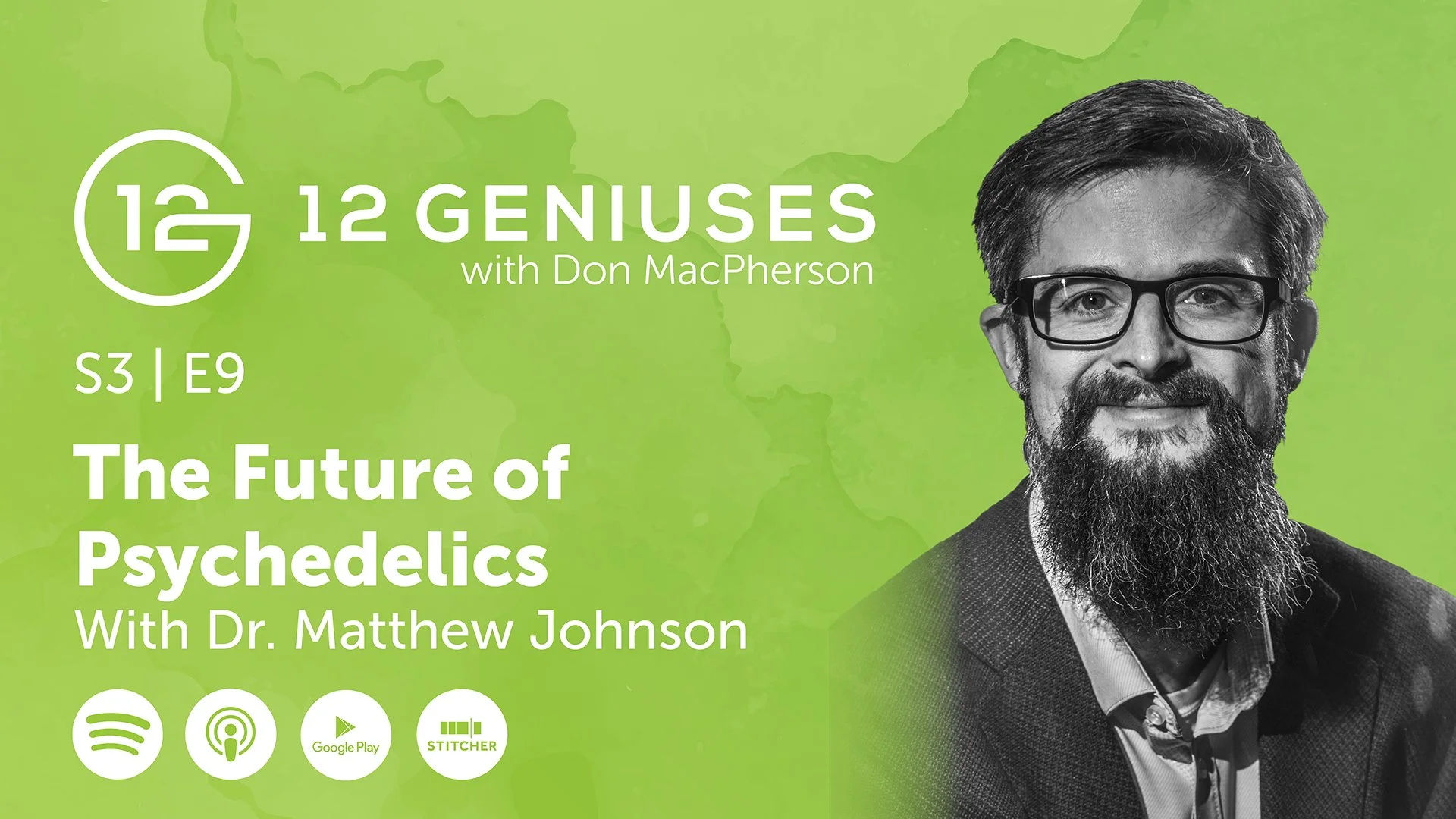
In this interview, Don MacPherson is joined by Dr. Matthew Johnson, an expert in psychoactive drug effects, addiction, and risk behavior. They discuss clinical research on psychedelics including psilocybin, ayahuasca, DMT, MDMA, LSD, and more. They dive into potential therapeutic applications for psychedelics including treating depression, PTSD, and addiction. They also explore the potential for psychedelics to improve individual happiness, creativity, empathy, and selflessness.
Season Three of the podcast is dedicated to exploring the future and how life is sure to change over the next decade. This episode provides insight into how research on clinical uses of psychedelics will disrupt the way we live and work.
Matthew W. Johnson, Ph.D., Professor at Johns Hopkins, is an expert in psychoactive drug effects, addiction, and risk behavior. He has worked with psychedelics since 2004. Dr. Johnson published psychedelic safety guidelines in 2008, which helped to resurrect psychedelic research. He developed and published the first psychedelic treatment of tobacco addiction in 2014. With colleagues, he conducted and published the largest study of psilocybin in cancer distress in 2016. His 2018 psilocybin review recommended psilocybin be moved to Schedule IV upon medical approval. He is Principal Investigator on upcoming psilocybin studies treating opioid addiction and PTSD, and LSD research treating chronic pain.
Don MacPherson:
Hello, this is Don MacPherson, your host of 12 Geniuses. For 25 years, I've been helping organizations and the leaders who run them improve performance. Now I travel the world to interview geniuses about the trends shaping the way we live and work. Today's topic is the Future of Psychedelics. Our guest is Dr. Matthew Johnson, a professor of Psychiatry and Behavioral Sciences at Johns Hopkins. He's one of the world's most published scientists on the human effects of psychedelics, and has conducted seminal research in the behavioral economics of drug use, addiction, and risk behavior. Dr. Johnson earned his PhD in experimental Psychology at the University of Vermont.
This episode of 12 Geniuses is brought to you by the Think2Perform Research Institute, an organization committed to advancing moral, purposeful, and emotionally intelligent leadership. You can learn more and access the institute's latest research at T, the number 2, pri.org.
Matt, welcome to 12 Geniuses. Let's start with your background and how you got into this field of studying psychedelics.
Dr. Matthew Johnson:
Sure. So, my educational background is I'm an experimental psychologist. That's what my PhD is in. And my undergraduate degree and, and master's degree were also in psychology. As an undergraduate, I became involved with psychoactive drug research. I was doing experimental research with rats, looking at a cocaine immunization, seeing if you could train rats to essentially tell you whether or not they've gotten cocaine on a particular day versus a saline injection. And then looking at this particular immunization if it could block their ability to tell whether they were on cocaine or not. So, I was getting very involved with the world of behavioral psychology, Skinnerian behavioral psychology, and psychopharmacology or behavioral pharmacology, basically studying psychoactive drugs.
Fast forward a few years, and it wasn't until I had gotten my doctoral in experimental psychology, then I was then able to, early in my time at Johns Hopkins, to conduct psychedelic research with psilocybin. And so, I've conducted research with psilocybin and some other psychedelic drugs and the time since. And so, now it's what? 16 years later.
Don :
Could you give us just an overview of the types of psychedelics that are being studied, not just by you and Johns Hopkins, but by other universities or other labs around the world?
Dr. Matthew:
Yeah. So, the biggie these days is psilocybin. That's the one that we've done most research with. And that's the one that's the subject of most research around the world. So, psilocybin is the primary active constituent in so-called magic mushrooms. That's the primary classic psychedelic. And by classic psychedelic, I mean compounds that have their main effects exerted through a particular subtype of serotonin receptor, the serotonin 2A receptor. And so, these classic psychedelics, aside from psilocybin, are LSD, DMT or dimethyltryptamine, which is in ayahuasca, which is in peyote and some other cacti. Those are the primary examples. Beyond that, you have this broader category of compounds that some people want to call them psychedelics; others may not. In that broader category of psychedelics, you have MDMA, methylenedioxy, methamphetamine, sometimes known as ecstasy, or molly, or X in the club scene.
And so, it's not a classic psychedelic. It works through a fundamentally different way, although there are some overlaps. It's a broad-based serotonin releaser that that's sort of on par with psilocybin in terms of its clinical advancement. So, some substantial research has been done investigating it in the treatment of PTSD, and that work is now moving into phase three trials. And then outside of that, there's some other research that has gone on with LSD, primarily, well, really only up until this point, in Europe. Still, psilocybin has been more commonly studied than LSD, but there have been some LSD studies. I've recently received funding from the HÉTFA Research Institute to conduct some LSD research. This would be using LSD to treat chronic pain; following up on some very promising early work with LSD.
And there's some research with ayahuasca, again, which contains DMT. And then there's other compounds, again, in the broader class of, not classic psychedelic, but in the broader class of psychedelic salvinorin A, which is in the plant salvia divinorum. My colleagues and I conducted the first human controlled research to show psychoactive effects of that compound — salvinorin A. And so, that's another compound that's been at play. And ketamine, there's a whole lot of research that's been conducted on its use as an antidepressant. And in fact, it has been approved as an antidepressant, at least one form of the molecule, esketamine is FDA approved for the treatment of depression. So, yeah, in broad strokes, that describes the different compounds that have been investigated.
Don:
As I was preparing for this discussion, there were a lot of myths that I bought into that just seemingly are not true. So, could you dispel some of the myths around psychedelics, like level of addiction, or if you have one bad trip, you'll go insane, or whatever the common myths are that are misconceived among the general population?
Dr. Matthew:
I guess the first one I’ll list, it comes up often as a question or a critique of our therapeutic use of psychedelics, particularly when treating an addiction. Like, the work I've done using psilocybin to help people quit tobacco smoking. One of the misconceptions or myths is that we're using it as a substitute treatment or a so-called agonist treatment. This is like methadone for opioid addiction. So, you use methadone instead of heroin, which is really the same thing as using nicotine patch or nicotine gum instead of smoking. These are basically ways to replace the same drug or very closely related drug that's going to have basically the same essential effect on the brain receptor that mediates that drug’s effects. So, this isn't that because all of the modern aero psychedelic research has used the so-called psychedelic therapy model, which means using one or a very small number of sessions where people have these very salient subjective experiences on a large dose.
And so, for example, in our smoking cessation work, in our first day, they had three sessions. Now we've scaled back, in our current study, to just having one session. And the idea is that that's going to impact a therapeutic process. People learn something from this experience, and that changes their behavior going forward. So, it's not like people are taking a mushroom pill every day. Because people will say, well, they're not smoking, but now they're tripping on mushrooms all the time. Like, no, no, no, no, that's… And when they are having the psychedelic experience, on that one day, they're, in a clinical research context, never left alone with all of the safeguards, which we could talk more about; with a physician who's able to step in at a moment's notice; with rescue medications; with the best of John's Hopkins medicine at the ready, just in case there's some anticipated effect — in case their blood pressure goes up a little bit too high and we want to be cautious and bring it down a little bit. All of that.
That's one myth. Another one, yeah, about people going crazy and never coming back. So, that's a complicated one. I think it's important to note that there is a kernel of truth there, even if it's distorted. It's pretty convincing from clinical observation that people that either suffer from a psychotic disorder, and that's something like schizophrenia, or they show a readily identifiable predisposition for one of those disorders. And in that broader category, we'd also include a related disorder of mania or bipolar disorder, which can exhibit some overlap with psychotic disorders. People with these disorders or predisposition, it appears that they could have lasting psychiatric reactions. It's not quite going on the trip and never coming back because the drug is out of their system and metabolized like it would be for anyone else after its typical time course.
But the idea is that the drug, and these individuals can destabilize them, and this shouldn't really be a surprise to anyone who's familiar with these disorders. I mean, if you are hanging onto consensus reality, so to speak, by a thread, and are extremely prone to experience delusions and paranoia, the last thing you need is a high dose of a psychedelic. It's going to exacerbate that. And it could trigger a lasting worsening of the disorder. That's through clinical observation. You can't really conduct an ethical study around that. That's a myth that's going to happen to anybody. But again, kernel of truth, like, we carefully screen people — there are vulnerable people out there. And when Tim Leary, for example, was more incautious, and at times he'd encourage essentially every teenager in America to turn on, that is to take a psychedelic, then there were casualties. Some people did have this predisposition. And the people with that predisposition aren't necessarily the best judges of their mental stability and whether they're equipped to do this safely.
Don:
In terms of risk for addiction, is it nonexistent?
Dr. Matthew:
I've spent 16 years, heavily involved with this research. I've talked to thousands of people inside of trials and outside. I love hearing about people's psychedelic trips. I'm not encouraging it, but I study this. So, I've conducted surveys, I've talked to people informally, I've never heard a convincing case of real addiction. See, but you got to really… to classic psychedelics, that’s to say mushrooms, LSD, DMT, mescalin, the stuff in that. You can get addiction to MDMA, you can get addiction to ketamine and some of these other compounds that are sometimes called psychedelics, but not the classic psychedelics. So, it's virtually unheard of. And in terms of the way these drugs work in the mesolimbic, the dopamine, so-called rewards pathway in the brain, they don't share that dopamine response that all of the addictive, the drugs that can be addictive from cocaine, all the way to even cannabis, nowhere near cocaine, but the drugs that basically can support a daily habit is the way I think of it.
Even with cocaine, most people don't become addicted. So, addiction isn't all about that brain response, but does it have addiction potential? The classic psychedelics don't show that signature either. And again, I've never heard a case of addiction. Now, they can be abused. You got to be careful about your language here. By abuse, I mean they can be used dangerously in extreme example, obvious examples, like a couple teenagers both eat a bunch of mushrooms and go driving around town. Like, yeah, really dangerous driving intoxicated. But a pattern of, like, their use interferes with their family life or their education or someone's career — those would be examples of abuse, but it's not the addiction. By that, I mean compulsive drug seeking.
Don:
Let's jump forward to potential uses. You talked a little bit about smoking and tobacco cessation. What does it look like in the future?
Dr. Matthew:
Yeah. For smoking cessation, there was… I conducted a very promising pilot study in 15 people. There was an 80% biologically confirmed abstinence rate six months after the intervention. And then even two and a half years later, 60% of people were biologically confirmed smoke-free. Then that allowed us to get larger resources. We’re in the midst of a randomized comparative efficacy study where we're randomizing people to get the psilocybin treatment or nicotine patch treatment with the same cognitive behavioral therapy, which is kind of the general type of thing that… Even the pamphlet that the doctor might give someone who's trying to quit smoking or the internet websites or the 800 quit lines. That type of thing. It's pretty standard self [inaudible 0:13:55] smoking cessation. But that's a backdrop to both.
And it's how we did our pilot study as well. And currently, most people were nearly done with that trial, but for the 44 people who have gotten to their one-year follow-up, we have a 59% abstinence rate for psilocybin compared to a 27% for nicotine patch. It's still looking extremely promising. The best medications in the field, I mean, at six months, you're talking about success rates in the 30 percents. That would be like Chantix. And then stuff like nicotine replacement can vary anywhere between 10% and 20 some percent in terms of success rates long term. If our results hold up, it's substantially better than anything out there. We got to continue the research, and maybe they won't hold up, but it's all an empirical question.
But I would anticipate, over the next three, four, five years, that this would proceed to phase three trials, and that, that would lead to FDA approval for people to receive this type of treatment. What that would mean is you go… You wouldn't just go get some from your doc and take two and call me in the morning. It would be, just like we're doing our trials — you come in, you go through screening to make sure it's not going to be particularly risky for you as an individual. That you're prepared for the experience. You develop a therapeutic relationship with the people who will be there with you to guide you through your experience, which is important for minimizing paranoia and the so-called bad trip. And we have medical monitoring, and blood pressure, and all of that.
And then they have their session. And it may one session and maybe a small number of sessions, like three sessions — but something like that. And there's follow-up care where they visit. It's conducted like outpatient surgery in the sense that they come in, on the day they receive the medication, they come in that morning, they receive it, they're there all day, and when they're done, at the end of the day, a loved one comes and take you home. You're not driving even though the drug's pretty much gone. Just to be safe, someone's taking you home, and you're following up to discuss the experience the next day. And then depending on the study, it could have a number of those follow-up visits. So, that's how clinical care would proceed. This stuff might be in its own clinics
Don:
And these would be distributed around the country and you'd have to have some sort of FDA approved guide or clinician involved?
Dr. Matthew:
Right. And it could be integrated into existing hospital systems and healthcare systems or standalone clinics. That's the stuff we don't really know how it's going to exactly play out in the marketplace. But yeah, I mean, the drug certainly would need to be FDA approved. And then it is a medicine, so you need a physician who is prescribing it and who's license is on the line. And there would be what's called, I'm a strong proponent for, and I'm sure there would be, a REM system — that's FDA language risk evaluation and mitigation strategies. It's like, here's this particular drug, here are the dangers. Much of my work is focused on this, like what this would look like. Here are the factors that need to be in play. You can't just use this; you can't tell your patient, “Take two and call me in the morning.” He needs to be in the clinic. People need to be prepared for the experience.
You need to look out for them and be there with them during the session. Address all the risks the same way we're doing in our clinical research. So, there won't be this sort of wild west like you do see in the cannabis world where there's no guidelines for a lot of what's going on.
Don:
Could treatment of drug and alcohol addiction be very similar to what you described for tobacco?
Dr. Matthew:
Yeah, absolutely. And in my world, tobacco is just another drug. So, they're all drugs whether they're legal or not. But yeah, there's very promising results from my colleague, Michael Bogenschutz, who's now at New York University looking at alcohol use disorder treatment or alcoholism. And it's preceded really along a parallel track. Very promising pilot research. Led to randomized research that, I believe, has recently wrapped up — not published yet. But that follows from older studies in the ‘60s and ‘70s on the use of LSD to treat alcoholism. And those looked like very promising findings that I was ashamed that the rug was pulled out from underneath that research effort back in the day. And my colleague Peter Hendricks at the University of Alabama, Birmingham is finding really promising initial results in treating cocaine addiction. If those results hold up, that would be a game changer because over a hundred medications have been tried as potential treatments for cocaine addiction, and nothing works.
Don:
Is that using LSD or psilocybin?
Dr. Matthew:
Using psilocybin. All of the clinical work, the therapeutic work so far has been using psilocybin.
Don:
I'm going to run through a number of other potential uses. How about for trauma? You talked about MDMA and some of the studies that are being done using MDMA to treat trauma. What do you think that looks like in the future? And also, are there applications for psilocybin to treat trauma or LSD?
Dr. Matthew:
Well, first, my prediction with MDMA is that is going to be approved for treatment of PTSD in the next few years because that looks extremely promising. The data are very strong. These are big effects. Many people come out of these trials long-term, and the category of it looking like a cure. I mean, they look like they don't even qualify for the disorder anymore. If the data hold up, that's going to be on the market at one point, and hopefully treat it safely the way I described earlier. I think other compounds are very promising for this. As part of our center, I have funding to conduct a study using psilocybin to treat PTSD. So, I haven't started it yet, but I've started the regulatory process.
It takes up to a year to jump through the various hoops for these studies just to get them started, even once you have the funding to conduct them. That's underway. From anecdotes, from people going down to South America, for ayahuasca retreats, a lot of veterans are doing that from these — and people who have taken psilocybin and LSD. I think it's a very good hypothesis that psilocybin and these other classic like potentially LSD or DMT, which is in ayahuasca, that they would not just be also effective like MDMA for PTSD, but maybe even more effective. Some folks say that the classic psychedelics are even better in the sense it's a… They're not as soft as MDMA. The experience can be more difficult, but that almost involves… It may be that, while a little more clinically challenging for people to go through these sessions, that's the nature of overcoming trauma is through exposure therapy.
During these sessions, people, very strongly, reprocess and deal with the traumatic material. And that process might be even more effective with something like psilocybin, but it's an empirical question, so we'll see. Yeah, hopefully I'll have some results in a couple of years about whether that holds up.
Don:
What do you think about terminal illness? I know there have been studies on terminal illness and using psychedelics for helping people to accept their mortality. What do you see as the future there?
Dr. Matthew:
That's actually the most advanced. It's ironic that that's not the thing that's moving forward into phase three trials, because that has the most solid science behind it. We conducted the largest study at Johns Hopkins of 51 cancer patients. They weren't all terminals. Some were explicitly terminal. And that can be a gray area, but it was all life threatening, and people had substantial anxiety and/or depression. And I tell you what, I talk to every one of these 51 people before, during, and after this whole process. Those issues that people are dealing with at end of life or potentially end of life are just psychedelic treatment is such a perfect fit for this. People's lives were transformed. The last months of their lives were transformed because obviously a number of people have passed away now, and that has a ripple effect on their family. People going from completely isolated and demoralized to actually embracing life up until the end.
Don:
Why do you think that is? What’s happening to the brain or what's happening to them? What sort of experience are they having that's making this happen or enabling this?
Dr. Matthew:
I think it's the thing that really is in common with all these other disorders. I think there is a degree of stuckness, of people being stuck in a certain way of thinking. And that can be exhibited in a behavioral pattern like the addiction to a substance like tobacco or alcohol or cocaine, or an addiction to a way of thinking, like in depression; people with these self-persecutory thoughts, “I hate myself, I'm a loser, I'm never going to make it.” These types of things. And with cancer, you get a really particularly insidious form of that where just they've been beaten down. And then cancer is particularly insidious because, even if you have something initially and it's taken care of, tumors removed and you're in remission, the idea it could come back out of nowhere and grow so fast, it's sort of a little more insidious than like heart disease because at least you have some clinical indicators there. Okay? Is your blood pressure under control?
And that tell you a little bit more about your chances and with cancer; that then could just pop out of nowhere, and it's just not fair. But so often the classic tale is that people have these powerful experience where they're dramatically shaken out of their context. Everything that they've been stuck in, in their life, whether it's the addiction or their obsession over the cancer, the disease about the unfairness, about being stuck in this hole that they're never going to get out, and they can't plan for anything in life. And they're just shaken out of the… I think it's just the radical way in which the brain can operate, the mental flexibility during the session where people can really think about their life from a radically different perspective. People often said, it's just so obvious, like they've been creating their suffering.
Don:
That shrinking of the ego is what I've read about.
Dr. Matthew:
Right.
Don:
Greater sense that I belong to something bigger than just me.
Dr. Matthew:
Right. That they call it the ego; that they are creating this. It's this story that they've gotten addicted to, woe is me. And it is tragic and serious, but at the same time, the realization is like, for these people, at least the people in our study who they weren't in hospice yet, and I think it could even be applied if they had been, but like they could still live life, whatever that means for them. And that was just this obvious thing that really hit people in so many of these cases that…
Don:
So huge.
Dr. Matthew:
And it seems like one of these things, and you describe it, it's like, I call it these duh experiences, like, “Well, duh, anyone could have told them that.” And people say that with smoke.” I remember this one guy, he quit smoking, he's like, “I just have to decide.” He said, “It's like flicking a bug off of me.” It's like, “I'm done.” That sounds so simple. So, it's something, it's not a cognitive shift. There's something deep… It's something we don't really fully understand, but it's a deep shift in the psyche, a deep shift in priorities and how people are making sense of how they fit into the world.
Don:
Could psychedelics be used to help prisoners reform behavior? I know there was a study done in the, I think the ‘60s that was seemingly positive, but I think there was some fake data and some data manipulation.
Dr. Matthew:
It's called the Concord Prison experiment that Tim Leary conducted. Yeah, there were some creative statistics involved with that and some just broader methodological. They spent more time with the people and the experimental group, and this type of thing. Rick Doblin has a good piece breaking down the limitations in that study. And there was a few other accounts in the literature besides that, that suggested there might be something there. This was really an interest… I mentioned Peter Hendricks earlier with the cocaine study. He also conducted a survey study and he roped me in to give him a little bit of help with it, but he was the leader of this project — looking at essentially a probation database of over 25,000 people in the southeastern United States.
And looking at this database found that after controlling for as many relevant variables as you could find that the use of a psychedelic was associated with substantially less likelihood of recommitting a crime. And so, this wasn't an experiment. So, it wasn't like what Leary tried to do. And there's always, correlation doesn't necessarily equal causation, but it's intriguing. And the thing for me in the database that really made it a little more convincing that there might be something there is the fact that every other drug of abuse, for the most part, showed the opposite trend, as you might expect a history of using cocaine, that they were more likely to go back to prison — and pretty much all of them. So, there was this pop out effect. So, it wasn't just doing something illicit, like taking any of these drugs, including psychedelic as illicit.
It wasn't just that. It was, it's likely, although again, you don't know for sure, because again, it's still just a correlation. But it seems plausible that there was something going on there. And there are plenty of anecdotes of people saying that they changed the course of their life because of a psychedelic experience.
Don:
The reason I ask this question is because through the stories I've read, people have come out of a psychedelic experience with a greater sense of compassion, this greater sense that we're unified. And so, I thought, well this, not to say that all prisoners don't have compassion or don't have a place in society, but it seems like that may be something that could benefit prisoners. So, that's what I was thinking about.
Dr. Matthew:
Yeah. Antisocial personality disorder, like on average, yeah, they could use a boost there.
Don:
One more curve ball on this potential use, and there's nothing that I've seen on this, but just a hypothesis I have. How about for Alzheimer's patients? And the reason I ask this question is because, as I was reading about it, and you alluded to it before, this default mode network, this is always the way I've done things. And for a lot of Alzheimer's patients, well, my theory is that helping them understand a broader range of the world and perception and things going on around them could activate something in their brain.
Dr. Matthew:
So, we're actually conducting a trial right now. It's open for…
Don:
All right.
Dr. Matthew:
If any people are listening who have loved ones, or themselves might qualify, check out our website at hopkinspsychedelic.org. This is specifically for early-stage Alzheimer's patients, so in the early progression of the disorder. the main hypothesis is that it might help quality of life and mood. Just like with cancer, this is another sort of existential threatening disorder, not just losing your life but losing even your identity before you lose your life. It can be horrifying. And we know that even how people dealing with that prognosis is even predictive of their disease progression. Because it could obviously be terrifying. To get this news and then how you could fall into a hole just at that level. Even though your memory is still pretty darn good right now and you're okay now, your quality of life may be shot to hell because of this existential hit on what's to come.
That's kind of the first level. But then the other level is in line with what you're saying, we do think it's more secondary because we think that the mood issue is more of a… In the scheme of things, it's probably more likely, given what we saw with cancer, but the idea that we could actually, maybe help to preserve some memory, with the idea that this is such a salient experience tied to sense of identity. And there's also some animal research suggesting that the receptor that psilocybin hits, that serotonin 2A, it can have some effects. And if you use it in the right way in enhancing learning and memory, there's a possibility that maybe we will affect, so basically the cognitive decline. So, we will be studying that as well to see whether people look like they're holding on to their cognitive functioning to a greater extent because of the experience. Yeah, your speculation is right in line with ours.
Don:
Good. Well, if you need an assistant, let me know. My last question for you is on use in people without a health concern — well people. Where I'm going with this is potentially enhancing creativity or maybe even bridging some political divide that's hampering our country and other countries around the world; development of leadership skills. And one of the things that we talk about in the leadership field is having empathy and emotional intelligence. What's the future look like for well people?
Dr. Matthew:
We've been actually predating all of our work with therapeutic populations like cancer patients or people that want to quit smoking and people with depression, which is another line of work we've looked at, outside of cancer that is. Predating all of that has been work with healthy normal. That what we generally found is that even if there's not a nominal problem to treat, these experiences tend to be extremely highly valued, very personally meaningful to people. And they have a sticking power where people say there is positive behavior change and quality of life change that's seen over a year later. And the behavior change here is more idiosyncratic because they're not coming in with one thing to treat, like, “Help me quit smoking,” for example. Some people say, “Oh gosh, my diet is so much better.”
Some people say, oh, the relationship with their husband. I mean, sometimes even saying the sex life with their husband is so much better than it used to be. And some people saying like, they're exercising more and they're less likely to hold grudges, and this type of thing. So, it's more idiosyncratic. So, you see these reports of changes in behavior. And we not only see that, those reports from people, but we've recruited people around them — their spouses, their coworkers, their neighbors, who have signed consent to be surveyed about the participant. And their reports also suggest these types of improvements. So, there seems to be something going on there. We need to get further into… What I've described so far is very general. We have done some work with meditation, seeing if it could help jumpstart and get more pro-social value out of a meditation, people starting a meditation program.
And we basically found the answer is yes, that people who had psilocybin, in addition to starting a meditation program, had more pro-social outcomes. They reported more altruism, for example. But there's a number of things; you mentioned creativity — that's something we'd like to look at. We haven't yet looked at. There's some older research, not pretty primordial, but suggesting that there are, like I said earlier, plenty of anecdotes in this category; that this could help people with their creativity. I have a study that it's not up and running yet, but it's going to be looking at creative professionals who feel like they've had some sort of burnout, and to see if psilocybin can help sort of relight the fire for them. I think there's lots of work to be done there. And in terms of what the future looks like for this, this is all research, but the FDA doesn't approve drugs for healthy normals.
They approve drugs for disorders. I'm not the expert on where this is going to lead to in terms of whether they're… Is the research going to lead to somewhere where healthy people can have access to these substances in a safe setting? I mean, that would probably require just a different infrastructure surrounding, the regulation of that, but I could imagine it potentially going there someday. And if it does, I would just hope that we keep following the data; that we keep things safe’ that people are… We understand the, the dangers and the risks, and that we have all the mitigation strategies in place to address them.
Don:
Yeah, it's exciting stuff. We didn't talk about set and setting, but I would imagine that whether you're using it to treat an illness or it's being used by healthy normals, set and setting would be very, very important protocol to keep in mind.
Dr. Matthew:
Absolutely. Yeah, and it's always nice, and that's the way we should proceed if it's approved. Our session room looks more like a posh living room than it looks like a research laboratory. That's what you want. You want a comfortable environment.
Don:
Dr. Matthew:
And you want the people, even more important than the physical environment, the people around, and who are with the person during the experience. You want a relationship beforehand, and then you want them to be there. A warmth and a caring, I think that that has to pervade it. That's the most important part of set and setting.
Don:
Yeah, that's absolutely important. This has been a phenomenal conversation. Thanks for your time. Where can people learn more about you and the research that's being done at Johns Hopkins?
Dr. Matthew:
People can learn more about our research at http://www.hopkinspsychedelic.org. And you can learn about what trials we have ongoing right now about research we've done in the past, and all kinds of cool stuff.
Don:
Matt, again, thank you for your time. A fabulous conversation — very, very interesting, and thank you for being genius.
Dr. Matthew:
My pleasure, Don.
Don:
Thank you for listening to 12 Geniuses, and thank you to our sponsor, the Think2Perform Research Institute. Our next episode of the show will be The Future of Privacy with Carissa Véliz, a Research Fellow at Oxford University, and the author of the upcoming book, Privacy is Power. Devon McGrath is our production assistant; Brian Bierbaum is our research and historical consultant; Toby, Tony, Jay, and the rest of the team at GL Productions in London make sure the sound and editing are phenomenal. To subscribe to 12 Geniuses, please go to 12geniuses.com. Thanks for listening, and thank you for being a genius.